Dúchas
For centuries, Irish folklore has flowed through water, trees and stone. Here, four of those stories find quiet echoes in the landscape and experience of An Sruthán.

Long before Fionn mac Cumhaill became one of the great figures of Irish legend, he studied under the poet Finnéces beside the River Boyne. For years, Finnéces had waited for the legendary Salmon of Knowledge, a fish said to carry extraordinary wisdom.
When he finally caught it, he asked Fionn to cook the salmon, warning him not to eat any of it. As it cooked, Fionn burned his thumb and instinctively put it to his mouth. In that small, accidental moment, the wisdom Finnéces had sought for so long passed to Fionn instead.
The story is one of patience, discovery and the limits of trying to force what cannot be hurried.
Finnéces spent years searching for wisdom. Fionn found it in an unplanned moment beside the water. There is something enduring in that idea: some things arrive only when we stop reaching for them and allow ourselves to be present enough to receive them.
There is something similar in the simplicity of moving between fire and water.
In the sauna, attention returns to heat, breath and the sound of water meeting stone. In the plunge, the cold demands your full presence. Between rounds, there are trees overhead, spring water moving beside you and nowhere in particular you need to be.
For an hour, there is very little to solve.
An Sruthán is not a place to search for answers. It is a place to step away from the noise long enough to notice what emerges in its absence.
Wisdom swims in quiet currents.
Trees hold a special place in Irish folklore. Old, solitary or striking trees have long carried stories and significance: some associated with the unseen world, some protected, some simply left standing even as the landscape around them changed. The deeper idea is that not everything in nature exists for us to alter.
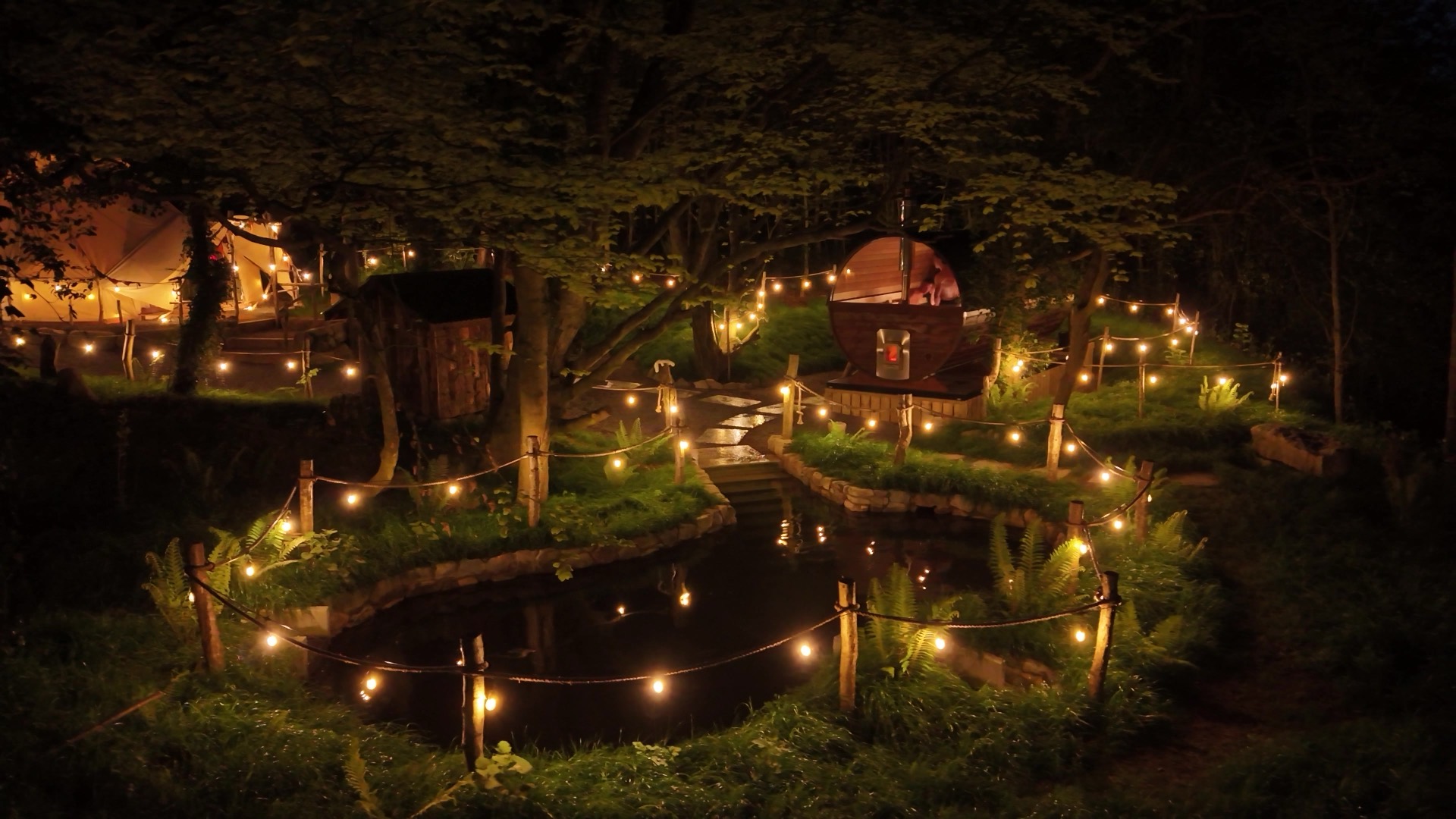
Towering over the spring-fed plunge is a great beech tree. Its canopy stretches across the water, casting shade in summer and changing the whole atmosphere of the pool through the seasons. Long before there was a sauna here, it stood over this part of the land. Within the story of An Sruthán, this is our fairy tree. You plunge beneath its branches, sit in its shade, watch the rain move through its leaves.
Respect what was here before you. Old granite is reused. Natural bends in timber are kept. The spring continues to flow. The landscape works around the trees, and imperfections stay visible. The fairy tree isn't just something to look at. It reflects how An Sruthán itself was built.
One of Ireland's great stories of endurance and transformation. Lir's four children, Fionnuala, Aodh, Fiachra and Conn, were transformed into swans through an enchantment. Their ordeal lasted centuries: years on Lough Derravaragh, the wild Sea of Moyle, and later the waters around Erris. Cold. Storm. Isolation. Time. Yet their bond endured, and eventually the enchantment ended.
Endurance, transformation, and perseverance through challenge. The world around the children changes, their bodies change, their circumstances change, yet something within them remains.
The ritual carries a smaller, symbolic echo of that same idea: moving repeatedly between heat and cold, comfort and discomfort, intensity and stillness. You sit within the heat. When ready, you leave, and step into cold water. For a moment, attention narrows completely to the present. Then recovery: the body settles, the mind settles, and you return to the heat.
The intention is never discomfort for its own sake. There's nothing to prove. But moving voluntarily through small moments of challenge can remind us that discomfort passes. You move through it. You recover. You begin again.
Endure. Transform. Return.
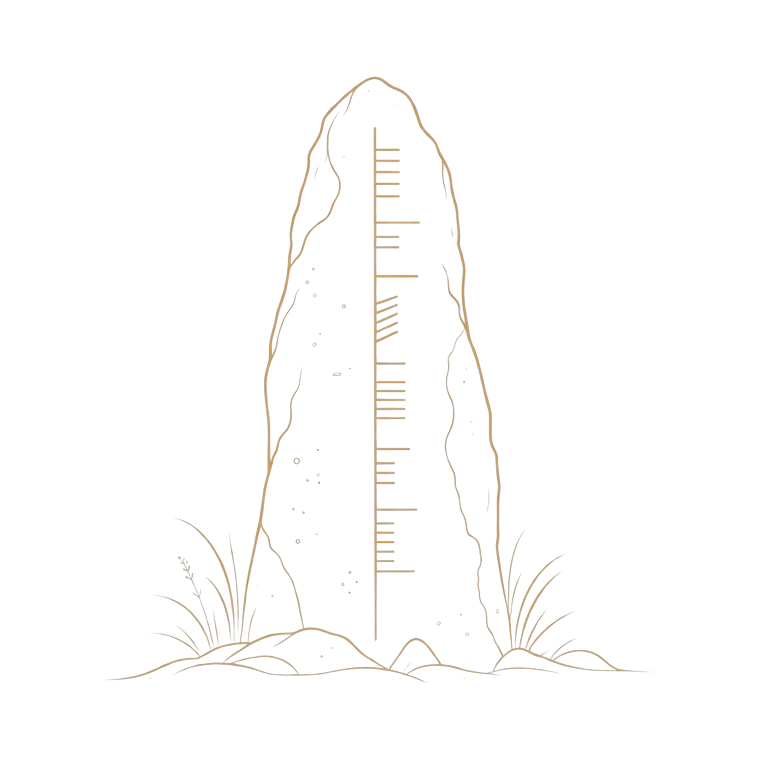
Ogham is one of the earliest written forms associated with the Irish language: inscriptions formed from groups of lines and notches cut along the edges of standing stones. Many surviving stones commemorate people, lineage or connection to place. Simple marks cut into stone carried identity across centuries.
Stone throughout An Sruthán has its own history. Many of our old granite gate pillars were recovered from ditches and boundaries around the surrounding farm, some still carrying the original drill and splitting marks made when those huge pieces were worked by hand.
Those marks are not historical Ogham inscriptions, but the lines and notches naturally echo the visual language of Ireland's ancient inscribed stones. We chose to preserve them: old gateposts became benches, discarded granite became resting places, standing pieces became part of the landscape again. Like Ogham stones, they retain the marks of those who came before.
An Sruthán does not attempt to erase age or imperfection. The history of a material is part of its value.
Nothing has to lose its past to be given another purpose.
Four Stories. One Landscape.
Wisdom. Respect. Endurance. Memory.
Old stories, finding new echoes in the landscape around us.